
Make Salesforce Skills Visible with a Small Evidence Portfolio
Turn one clearly labeled practice project into evidence of requirements, decisions, testing and communication without inventing client results.
Topic inspiration: Salesforce Ben’s career commentary on the 2026 10K report, published 30 October 2026. The practical framework below is original iTeknologies editorial analysis.
A skills list says what you have studied. A small evidence portfolio can show how you turn a request into a decision, test the result and explain the work to someone else.
You do not need a large fictional enterprise or an invented client success story. Choose one bounded problem and make your contribution easy to inspect. The framework below is useful for a learner, an administrator seeking broader responsibility or a team lead reviewing development needs.
Choose a problem you can explain clearly
Consider this fictional practice project: a service team loses track of requests passed from intake to a specialist. Design a simple way to record the handoff, identify the current owner and show which requests are waiting for action.
Describe the starting problem without fabricated metrics. It is enough to say that the exercise explores ownership and visibility. Do not claim that your application reduced response time or saved money unless you actually measured that outcome in an authorized setting.
Keep the first version small enough to finish. Define the people involved, the records they need and the point at which a handoff is considered accepted. A clear scope gives the reviewer something concrete to assess.
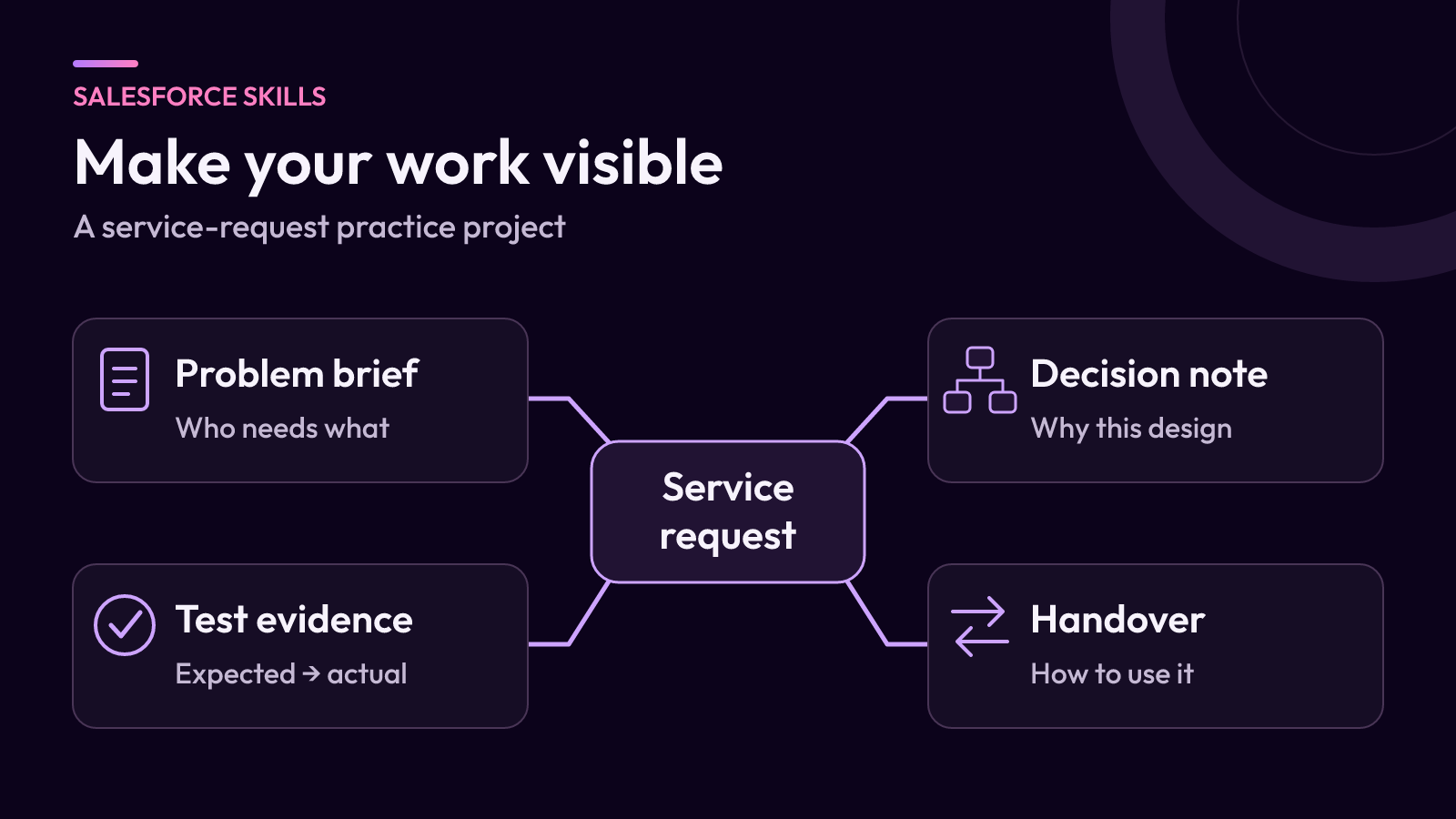
Prepare evidence in four parts
Organize the portfolio so someone can understand the project before opening the configuration.
- Problem brief: the user, the task, the constraint and the expected outcome.
- Decision note: one significant design choice, an alternative considered and the reason for the choice.
- Test record: expected and actual outcomes, including at least one failed case that led to a correction.
- Handover: how to use the result, what it depends on and what remains outside scope.
Salesforce’s user-story guidance explains acceptance criteria as clear pass/fail statements. For this example, one criterion could require the current owner to be visible after an accepted handoff. Another could require that an unaccepted handoff remain distinguishable from accepted work.
These are original practice requirements. They are not claims about a customer’s process or a standard Salesforce feature. The implementation and evidence should make that distinction clear.
Make one decision worth discussing
Suppose you must choose between a single current-owner field and a separate handoff history. Explain what each option lets a team answer. A current-owner field may answer who owns the request now; a history may be needed to inspect previous transfers.
State what the practice scope requires and what you would reconsider if that scope changed. The value of the note is the reasoning, not choosing the most complicated model.
Include a diagram only if it makes the decision easier to understand. Use readable labels and show the relationships that matter. A crowded drawing of every available object can obscure the choice you are trying to explain.
Build and test in an appropriate environment
Salesforce provides Trailhead Playgrounds for hands-on practice apart from production work. Use fictional records and confirm that the features you need are available in the training environment.
For the handoff example, test a normal transfer, a missing recipient, a request returned to intake and an edit by someone who should not change ownership. Record what actually happens. If a check fails, show the correction and the retest.
Be specific about what you implemented yourself and what came from a tutorial, template, collaborator or AI tool. A reviewer should be able to distinguish your decisions from the starting material. Do not publish company configuration, customer data or internal screenshots without permission.
Turn the review into your next learning task
Ask a colleague to read the brief and predict what the application should do. Then let them use the evidence to judge whether it does that. Note where they need an explanation that the portfolio does not provide.
Choose your next learning task from that gap. It might be a permission issue, a reporting question, a weak test or an unclear handover. Give the task a finish line, such as demonstrating that a restricted user cannot perform the handoff.
Keep the portfolio compact and current. Label practice projects honestly, date the evidence and remove claims you cannot support. The result should help a reviewer understand your work; it cannot guarantee an interview or a promotion.
For business teams, these same artifacts can clarify the scope of CRM strategy work and Salesforce administration support before implementation begins.