
Measure Agentforce Cost per Completed Task
Pair usage records with a clear completion test so an Agentforce pilot shows the cost of useful work, retries and human follow-up.
Topic inspiration: Salesforce Ben’s discussion of AI consumption and business context, published 30 October 2026. The practical framework below is original iTeknologies editorial analysis.
A pilot can produce plenty of agent activity while completing very little work. To judge its value, connect consumption to a defined outcome and include the attempts that did not reach it.
Cost per completed task is an internal measurement you can build for a pilot. It is not a universal Salesforce billing unit. Keep your analysis separate from the product’s actual meter and contract.
Choose a completion test before measuring cost
Use a narrow fictional example: an agent helps an employee locate the correct service request and prepare its status summary. A task counts as complete only if the correct record is identified, the permitted information is accurate and the employee does not need a manual correction.
Define the review method before running the pilot. Who checks accuracy? How is a request with several possible matches handled? Does handing the request to a person count as completion or as a separate outcome?
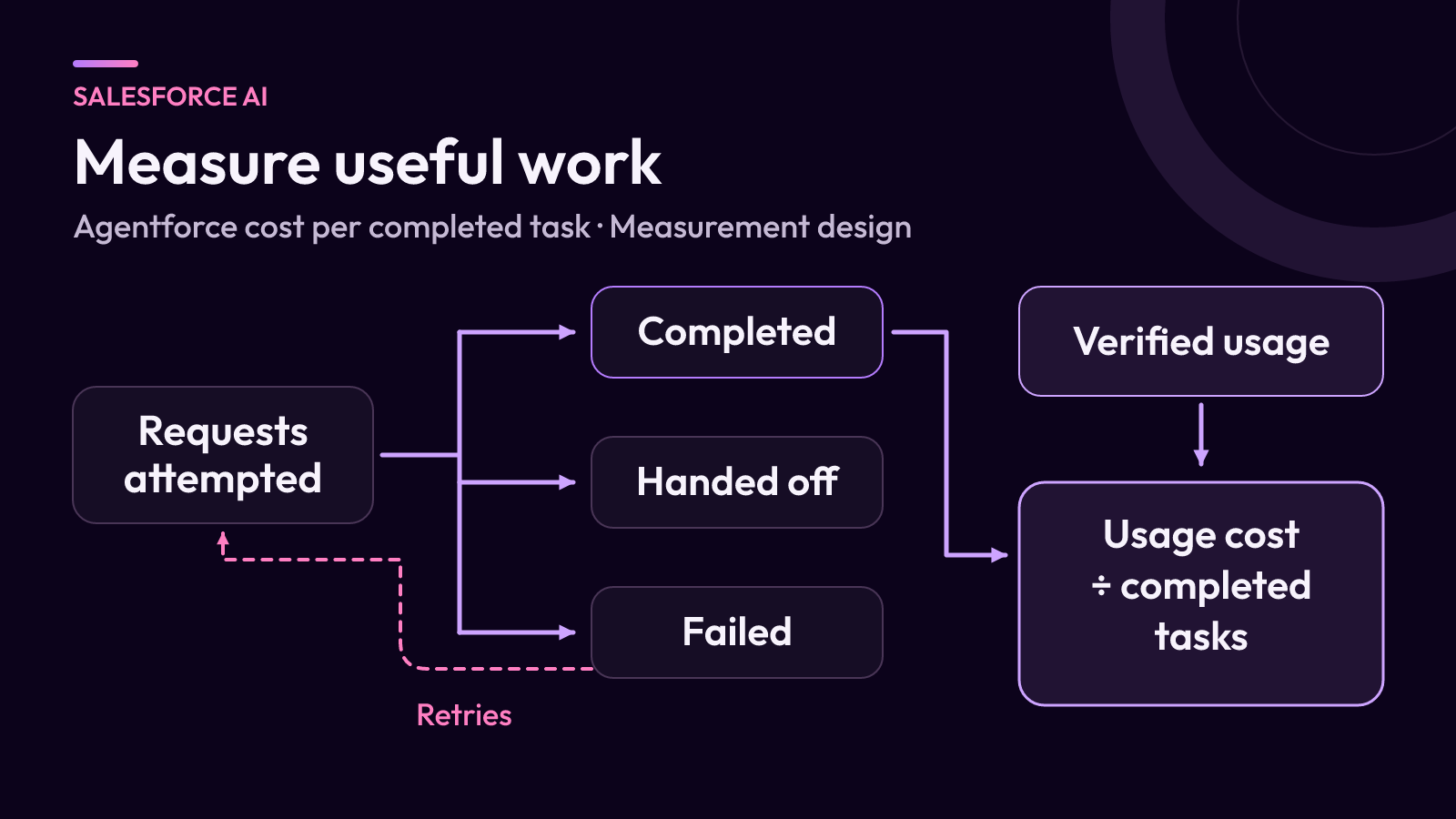
Keep the categories explicit: completed, correctly handed off, failed and still unresolved. A responsible handoff may be valuable, but counting it separately prevents a change in routing from looking like an improvement in autonomous completion.
Keep usage units and money separate
Salesforce’s Agentforce pricing page describes multiple consumption and licensing options. Start with the products and billing terms that actually apply to your org, including relevant dependent services. Do not convert a model’s token count into a Salesforce charge using a guessed ratio.
For each pilot run, capture the environment, agent version, request set, usage categories and observed quantities. Have the responsible billing owner confirm which rates and entitlements apply before turning that record into a monetary estimate.
Digital Wallet provides consumption visibility and configurable alerts. Use it as one source for the usage side of the analysis, then reconcile the reporting window and attribution with the operations performed. If the pilot shares an environment with other work, identify what you can and cannot attribute to it.
Calculate a useful pair of measures
Track completion rate alongside cost. A simple pilot worksheet can contain these two calculations:
- Completion rate: tasks meeting the agreed completion test divided by all tasks attempted.
- Usage cost per completed task: attributable metered cost for the whole test set divided by completed tasks.
Include failed attempts and retries in the numerator when their usage is attributable to the test. If no tasks complete, report the cost and the failure outcome rather than presenting a meaningless cost-per-completion figure.
Keep fixed licensing allocations, implementation effort and human follow-up time visible in separate columns. That makes the assumptions reviewable. A low metered cost can still accompany substantial manual work, and a small test is not automatically representative of a full month.
Compare one change at a time
Take a repeatable set of approved test requests. Include ordinary cases, ambiguous records, unavailable information and requests that should be handed to a person. Use the same completion criteria for every version.
Then change one aspect of the design, such as how the agent identifies the requested record or which information it retrieves. Record the change and repeat the tests. Do not remove difficult cases simply because they make the new version look worse.
Salesforce’s agent-testing guidance separates response evaluation from action evaluation. Review both kinds of evidence: a plausible answer and the intended operation are not interchangeable. Inspect actual outcomes when the two disagree.
Compare completion, incorrect responses, handoffs, elapsed time and usage together. Treat an apparent cost reduction as useful only after checking that the agent still completes the intended work with the agreed quality.
Set an operational response to unexpected usage
Choose a consumption threshold with the budget owner, then define what happens when the threshold is reached. Name who investigates, which pilot activities can be paused and how unresolved requests will be handled.
Keep a record of changed instructions, connected data and agent versions so a usage increase can be investigated. An alert tells someone to act; it should not be treated as proof that spending is automatically capped.
Use the worksheet to decide whether to expand, revise or stop the pilot. For work that connects agents with existing processes, explore Salesforce integration and automation. If the business outcome is still unclear, start with CRM strategy and consulting.