
How Do You Become A Salesforce Consultant?
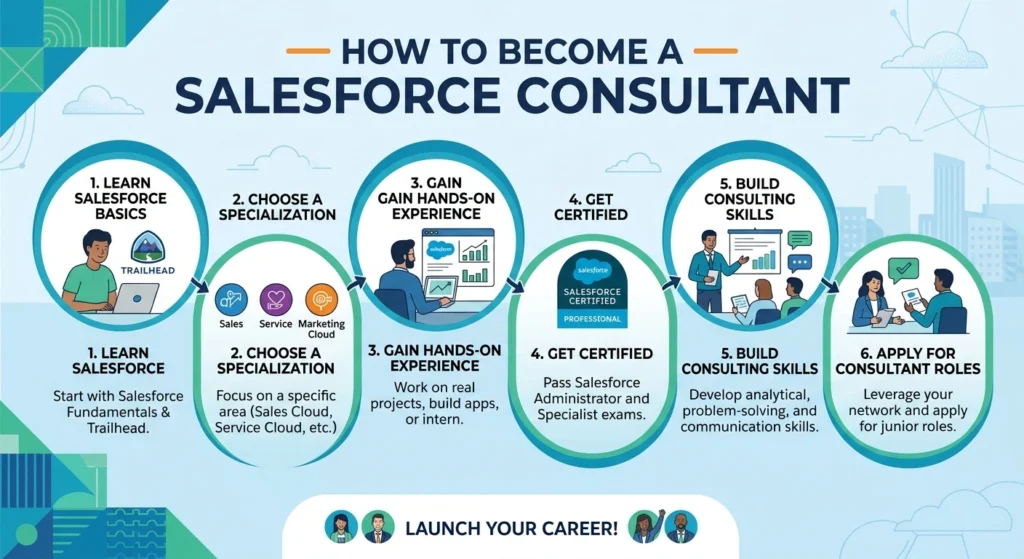
To become a Salesforce consultant, learn CRM fundamentals, practice Salesforce configuration, and complete a project that takes a business requirement through discovery, design and testing. Use the project to explain your decisions in interviews. Choose a certification that matches the kind of Salesforce work you want to do.
This guide explains how to become a Salesforce consultant using a practice project for a sales team. You can follow it from a background in sales operations, customer service, business analysis, IT or software development. Start with one workflow and build enough of it to show how you think and work.
What Is A Salesforce Consultant?
A Salesforce consultant helps an organization design and implement Salesforce around its business processes. A functional consultant typically works with stakeholders to define requirements, recommend a solution and check that the finished system supports the work. A technical consultant may spend more time on integrations, data architecture or custom development.
Job titles vary by employer. A small team may expect one person to run discovery and configure the system. A larger project may divide that work among consultants, administrators, developers, analysts and architects.
What Does A Salesforce Consultant Do?
A Salesforce consultant connects business decisions to the system people use. The work can start with a discovery workshop and continue through user acceptance testing, training and handover.
For a new sales process, a consultant might do the following.
- Discovery. Use stakeholder interviews to find where inquiries get delayed and who should own each handoff.
- Design. Agree how leads should be assigned, what happens when data is missing and which information managers need in reports.
- Build. Configure supported features or work with the administrator and developer to implement the agreed design.
- Testing. Ask representative users to complete realistic tasks. Record defects, retest fixes and capture the business owner’s acceptance.
- Handover. Document decisions, show users how to complete daily work and assign responsibility for maintaining the solution.
These activities fit into a broader rollout. For the sequence from discovery to launch, see our Salesforce CRM implementation guide.
How Does A Consultant Differ From An Admin Or Developer?
The distinction is the work each role usually owns. Teams often share responsibilities, so read the duties in each job description.
| Role | Usual Focus | Example On A Lead Assignment Project |
|---|---|---|
| Salesforce consultant | Understand the business problem, define the solution and verify it with users | Agree which team owns each inquiry and write the tests that confirm routing works. |
| Salesforce administrator | Configure, maintain and support the Salesforce org | Set up queues, user access and reports, then maintain them after launch. |
| Salesforce developer | Build and maintain custom code or components where the design requires them | Implement a custom connection to an external system when existing tools do not meet the requirement. |
If you enjoy working through unclear requirements with people and checking how a proposed solution will work day to day, functional consulting is a useful path to explore. Look at the tasks in job descriptions to see how much configuration, analysis or development each employer expects.
What Skills Does A Salesforce Consultant Need?
Build enough platform knowledge to judge what is feasible and enough business analysis skill to decide what is worth building. Practice explaining your decisions in language a user or manager can understand.
- Process mapping. Trace who does the work, what starts it, where it gets handed off and how it ends.
- Data and access. Understand how objects, fields and relationships store information. Learn how permission sets and sharing affect what people can do and see.
- Requirements. Write user stories, define acceptance criteria and distinguish launch needs from requests that can wait.
- Configuration. Practice with reports, layouts, validation rules and Salesforce Flow when the business process calls for automation.
- Testing and adoption. Create test scenarios, capture what passed, and prepare guidance users can follow after launch.
What Are The Six Steps To Becoming A Salesforce Consultant?
Work through one project as you learn. Each step should produce something you can review, demonstrate or improve.
1. Which Business Process Should You Learn First?
Start with a sales or support process you can describe clearly. A sales example might run from inquiry to qualification and opportunity management. A support example might run from an incoming case to assignment and resolution.
For sales, learn how standard objects such as Leads, Accounts, Contacts and Opportunities fit together in a business-to-business setup. Identify who owns each stage and which information must follow a record between stages. Salesforce explains how objects, fields and records fit together in its data modeling module.
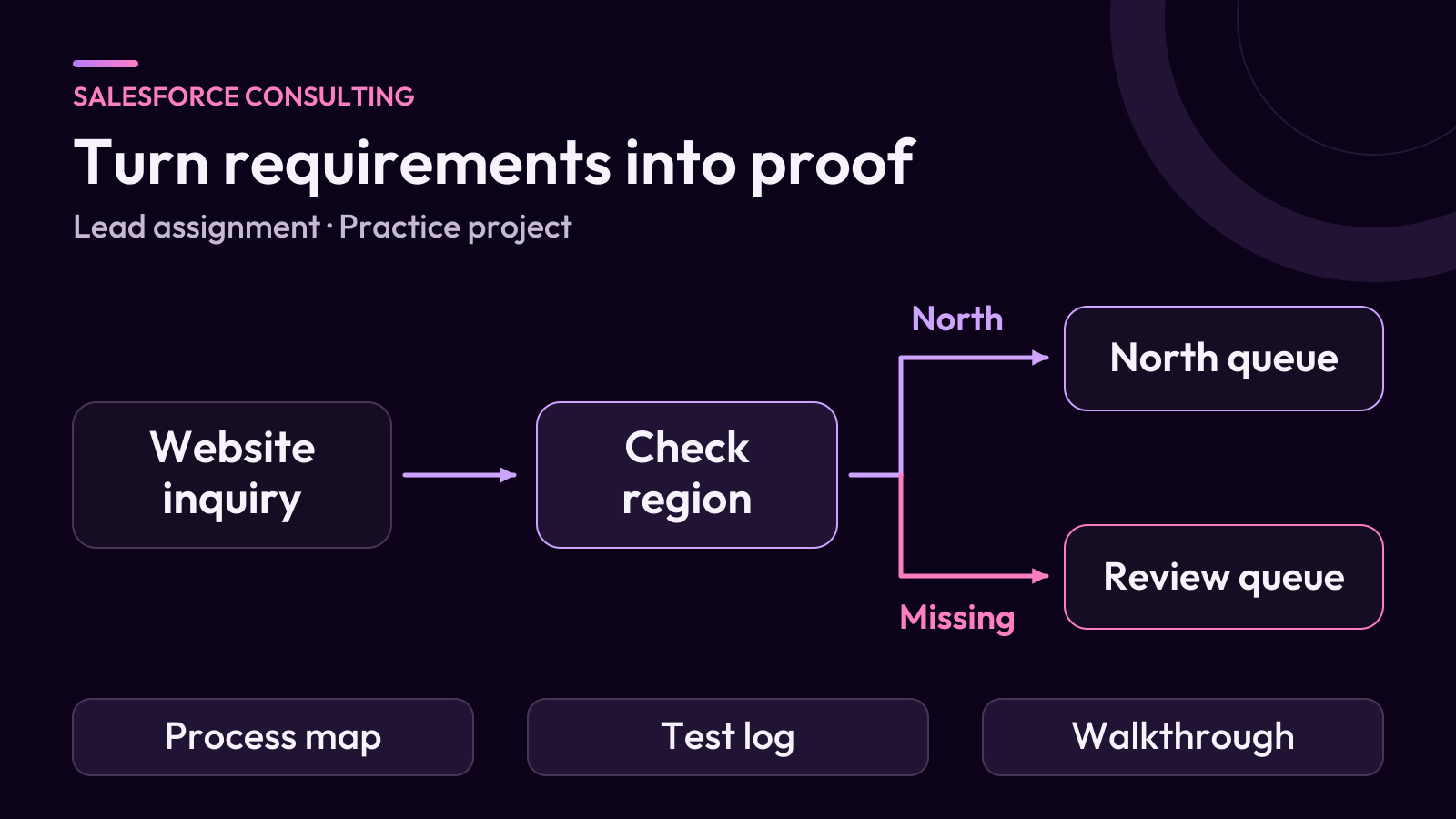
Write a simple process map for your chosen workflow. Mark the first input, the expected outcome and one exception. That exception will give you a more useful design exercise than a workflow where every record arrives complete.
2. How Do You Practice Salesforce Configuration?
Use a training org and synthetic data to create records, configure access and build a report. A Trailhead Playground gives you a place to try platform features and complete exercises. Follow Salesforce’s instructions for creating a Trailhead Playground.
Pick one practical task per feature. Use a validation rule to protect an agreed data requirement, build a report that answers a manager’s question, or use Flow for a repetitive task with a clear trigger and outcome. Keep the setup small enough to explain every field and rule you add.
For a second practice workflow with requirements, access checks and handover, try our Platform App Builder practice project.
3. How Do You Turn Discovery Notes Into Requirements?
Ask what the business needs to happen, who owns the decision and how users will confirm it works. A request like “automate lead assignment” still needs rules for region, ownership, missing information and exceptions.
Write a user story for the person doing the work. In the practice project, a sales manager wants website inquiries routed to the appropriate regional team so that representatives know who should follow up. Add acceptance criteria that state the input and the expected result.
Agree which features belong in the first release and who can approve a change. Track open decisions so you can tell which parts of the design still depend on business input. For examples of defining scope, milestones and ownership, see Salesforce’s statement of work guidance.
4. What Should Your First Portfolio Project Show?
Build a small project that shows the whole path from an agreed requirement to a tested solution. The following fictional lead assignment scenario is a starting point you can reproduce with sample data.
A sales team wants inquiries with a valid region routed to the appropriate queue. Inquiries missing a region should go to a review queue. The manager needs a report showing incoming leads by queue and which records still need review.
| Test Scenario | Expected Result | Evidence To Capture |
|---|---|---|
| A lead arrives with the North region selected. | The lead is assigned to the North queue when the configured assignment process runs. | Test lead and resulting owner |
| A lead arrives without a region. | The lead reaches the review queue. | Test lead and recorded fallback result |
| A user tries to open a lead that the sharing design restricts. | Salesforce denies access to the record. | Result for a representative test user, where the training org permits it |
| The manager reviews the lead report. | The counts by queue agree with the sample records. | Report and a count of the test records |
Record how you triggered the assignment rule or Flow so someone can reproduce each test. If your training org limits a test, document the scenario and mark it as pending. For any failure you find, record the change and rerun the affected cases.
Your portfolio can include a one-page brief, a process map, the decision to use a standard feature or automation, and a small test log. Label the work as a practice project and use results you observed in the training org.
5. Which Salesforce Consultant Certification Should You Choose?
Choose a Salesforce consultant certification based on the processes you want to support. Salesforce’s current Sales Cloud and Service Cloud consultant credential pages use the names Agentforce Sales Consultant and Agentforce Service Consultant. Both list Salesforce Certified Platform Administrator as a prerequisite.
| If You Want To Work On | Credential To Consider | Official Reference |
|---|---|---|
| Salesforce setup, configuration and administration | Salesforce Certified Platform Administrator | Platform Administrator credential |
| Discovery, requirements and stakeholder collaboration | Salesforce Certified Business Analyst | Business Analyst credential |
| Sales processes and Sales Cloud implementations | Salesforce Certified Agentforce Sales Consultant | Agentforce Sales Consultant credential |
| Customer support processes and Service Cloud implementations | Salesforce Certified Agentforce Service Consultant | Agentforce Service Consultant credential |
If you are new to Salesforce, build a configuration foundation before choosing a specialist exam. Check the official credential page for eligibility and exam coverage before booking. Hiring requirements vary by employer and role.
6. How Do You Turn Your Project Into Interview Evidence?
Choose one design decision you can explain from beginning to end. State the business problem, the options you considered, why you selected one and how you tested it. Keep enough detail to answer follow-up questions about access, exceptions and support.
For the lead assignment example, you could explain the decision to use a review queue for incomplete inquiries. Show a test where the record reaches the queue and describe who should review it. A short demonstration gives the interviewer a clear way to assess your reasoning.
Apply for roles whose duties match your evidence. Look for work that lets you contribute to requirements, configuration, testing or reporting under experienced project ownership. Use your CV and portfolio to show what you personally did.
Can You Become A Salesforce Consultant Without Experience?
You can start building relevant experience before your first Salesforce consultant role. Use your current skills to choose a practice project and look for supervised work that gives you responsibility for part of a real rollout.
- If you work in sales operations, document a lead handoff or pipeline reporting problem and build a sample solution.
- If you work in customer support, map how a case is assigned and escalated, then test the exceptions.
- If you work in IT or development, practice interviewing stakeholders and explaining the tradeoffs behind a configuration decision.
Junior business analyst, CRM administrator and implementation support roles can give you exposure to different parts of a project. Check the duties and training available in each role when deciding which positions to pursue.
How Long Does It Take To Become A Salesforce Consultant?
Your timeline depends on your platform experience, time to practice and the roles you pursue. Set a first milestone you can control, such as completing one project and being able to explain it clearly.
The following 12-week plan is an example for learning and building a portfolio project. A beginner who needs more practice can extend any stage.
| Example Period | Focus | What To Have By The End |
|---|---|---|
| Weeks 1–3 | CRM concepts, objects and training org practice | A mapped workflow and a small set of sample records |
| Weeks 4–6 | Requirements, configuration and reports | A working first version with written acceptance criteria |
| Weeks 7–9 | Exceptions, access tests and refinements | A test log, resolved defects and an explanation of remaining limits |
| Weeks 10–12 | Demonstration, portfolio and role research | A short project walkthrough and a list of roles or credentials that match your goals |
Measure progress by what you can demonstrate and explain. Schedule exams or applications according to your readiness and the requirements of the roles you want.
Do Salesforce Consultants Need Coding?
Many functional roles focus on requirements, configuration, testing and training. Technical roles may expect Apex, integration skills or other development experience. Learn to identify when a problem can be solved with standard features or Flow and when it needs a developer’s input. Salesforce compares Flow and Apex for record changes in its automation decision guide.
How Can You Start This Week?
Choose one workflow, create a training org and write three tests before you build. When you can show the requirement, the configuration and the results, use our Salesforce skills portfolio guide to turn that work into an example you can share.